Signed in as:
filler@godaddy.com
Signed in as:
filler@godaddy.com
Regenerative agriculture is not about chasing labels, ticking boxes, or making the farm look good in a brochure. It is about rebuilding the productive capacity of the farm. Starting with the soil, the people, the livestock, the crops, the finances and the decisions that hold the system together. At Spekboom Ltd, we help UK farmers and landowners plan and implement practical regenerative transitions that work in the real world. Our focus is simple:
This is regeneration in its most practical form: improving the farm’s ability to produce, adapt and thrive over time.

This practical set of resources is designed to help farmers, landowners and advisors assess current resilience, identify evidence gaps, prioritise opportunities and prepare for a structured baseline review.
UK farming is under pressure from every direction: input costs, market volatility, changing policy, extreme weather, soil degradation and succession challenges. The future will not be won by adding more complexity. It will be won by building farming systems that are more resilient, better understood and less dependent on fragile external inputs.
The case for focusing on soil is no longer theoretical. GOV.UK reports that, in England and Wales, almost 4 million hectares of soil are at risk of compaction, over 2 million hectares are at risk of erosion, and intensive agriculture has caused arable soils to lose around 40–60% of organic carbon. The Farming Advice Service also links healthy soils to improved nutrient availability, reduced need for artificial nutrient additions over time, greater resilience to flooding and drought, and more robust crop production
Regenerative agriculture is not a silver bullet. Evidence from UK and international sources shows that the transition can involve short-term trade-offs, including yield or margin pressure in some contexts. But the same evidence also points to the core opportunity: when designed carefully, regenerative systems can reduce input exposure, improve soil function and support long-term farm resilience.
We do not believe in selling farmers a fashionable framework and walking away. Regenerative agriculture only works when it is grounded in the reality of the farm. Soil type, enterprise mix, rainfall, machinery, labour, tenancy, cashflow, family objectives, markets and risk appetite all matter. That is why Spekboom LTD’s approach is not prescriptive.
It is not “do these five things and call yourself regenerative.”
It is a structured way of answering better questions:
That is where Spekboom LTD’s wider transformation philosophy naturally fits agriculture. Your farm is not a machine. It is a living system. When it is fragmented, expensive and reactive, it struggles. When it is understood, aligned and improved over time, it becomes more resilient.
Understand the farm before recommending change: soils, enterprises, finances, people, constraints, history and ambitions.
Align cropping, grazing, soil health, machinery, labour, cashflow and decision-making into one coherent system.
Use observation, measurement, field walks, soil testing, records and practical data to guide decisions.
Build confidence through clear plans, honest advice, visible progress and measured outcomes.
The result is not a generic regenerative plan. It is a farm-specific transition pathway that helps you move from “we should probably change something” to “we know what to do next, why it matters, and how to manage the risk.”
Understand where the farm is today before deciding where to take it next. This is a practical whole-farm review designed to establish your starting point. We look at the farm as a system: soil, enterprises, rotations, grazing, nutrient flows, water, biodiversity, labour, machinery, costs, risk and decision-making.
Best for: Farmers and landowners who want clarity before investing time, money or reputation in change.
A practical roadmap for moving from current state to a more resilient farming system. A transition plan turns ambition into a manageable sequence of decisions. It does not assume every farm should move at the same speed or adopt the same practices. It identifies the right changes for your context and stages them sensibly.
Best for: Farms that know they need to change but want a structured plan that protects cashflow and reduces risk.
Because better decisions start with better evidence. Regeneration should be measured, not guessed. We help farms build practical feedback loops using simple, meaningful indicators — not paperwork for the sake of paperwork.
Best for: Farms already changing practices and wanting to know what is working, what is not, and what to adjust.
Learn by seeing, questioning and discussing what works in practice. Regenerative agriculture is knowledge-intensive. Research highlights that farmers need training, peer learning, independent advice and context-specific support to navigate the transition successfully. We design workshops and visits around practical farmer questions, not abstract theory.
Best for: Farmers, family businesses, landowners, estate teams and discussion groups.
Support when the plan meets the weather, the workload and the bank balance. The hard part is rarely writing the plan. The hard part is changing the system while still running the farm. We provide practical support through implementation, helping you make decisions, adapt plans and keep momentum.
Best for: Farms moving from planning into delivery and wanting experienced support without creating dependency.
Continuous improvement for farms that want to keep learning and adapting. Regeneration is not a one-off project. It is a different way of running and improving the farm. We support ongoing reviews to help you track progress, adjust strategy and keep the business moving in the right direction.
Best for: Farmers and landowners committed to long-term stewardship, profitability and resilience.
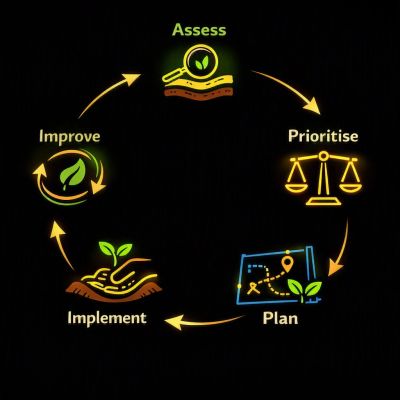
We start by understanding the farm properly; soil, system, people, finances, constraints and ambitions.
We identify where change will create the most value and where the risks need careful management.
We build a practical transition plan with clear steps, success measures and review points.
We support the changes on the ground, helping you test, learn, adapt and avoid costly mistakes.
We review progress over time and use real evidence to refine decisions season by season.
No two farms are the same. Soil type, tenancy, rainfall, family goals, enterprise mix and cashflow all change the answer. This mirrors Spekboom LTD’s core value of “Context First”: listen before architecting, map reality before proposing change.
Regenerative agriculture fails when it is treated as isolated practices. A cover crop, grazing change or reduced cultivation decision only makes sense inside the wider farm system.
Yield matters, but margin, risk, input dependency, soil function and long-term resilience matter too. Savills notes that net margin is more important than yield or revenue when evaluating regenerative agriculture.
The evidence is clear that regenerative agriculture is context-dependent and can involve trade-offs. We will tell you what looks promising, what needs testing, and where caution is needed.
This is not sustainability theatre. It is practical transformation for farms that need to make better decisions, protect long-term productive capacity and build a business that can handle uncertainty.
Please reach us at info@spekboomltd.co.uk if you cannot find an answer to your question.
No. At its best, regenerative agriculture is a practical direction of travel: improving soil health, reducing unnecessary input dependency and making the farm more resilient. It does not have a single agreed UK definition, and that is why we focus on principles, context and outcomes rather than labels .
No. Regenerative agriculture is not the same as organic farming. Organic has defined certification rules; regenerative agriculture is broader, more flexible and context-specific. Some farms may reduce synthetic inputs significantly over time, but the starting point is understanding what is right, realistic and safe for your system.
They might, depending on your farm, the practices adopted and the pace of change. Research and modelling show that transition can involve short-term yield or margin pressure in some contexts. That is why we focus on staged transition, margin, risk management and measurement, not reckless change.
Not always. Livestock can play an important role in some regenerative systems, but not every farm can or should integrate livestock directly. Some systems can use leys, organic amendments, grazing agreements or other approaches that deliver similar soil and nutrient-cycling functions.
Not necessarily. Some changes may require equipment, but many transitions can start with management changes, trials, collaboration, contracting or phased investment. The right answer depends on your soil, rotation, scale, machinery, cashflow and risk appetite.
Not for us at this stage. Those markets may become relevant for some farms, but Spekboom LTD’s core focus is farm performance: profitability, soil health, resilience and practical decision-making. We start with the farm business, not the credit scheme.
It can, but tenancy structure matters. Shorter tenancies can make long-term soil investment harder, so the transition plan needs to reflect the commercial reality of the agreement. We can help frame discussions between tenants and landowners around shared long-term value.
Some changes can show benefits quickly, especially around observation, decision-making, soil cover, input use and operational clarity. Soil structure, biology and system resilience usually require a longer view. The important thing is to establish a baseline and track progress honestly.
It should not. Good measurement should help decisions, not create admin for its own sake. We focus on practical indicators that are useful to the farm: soil structure, organic matter, infiltration, input use, costs, rotations, grazing decisions and margins.
Yes. We can support assessment, transition planning, workshops, farm visits, implementation and ongoing review. The aim is not to make you dependent on consultants. The aim is to help you build a stronger, more capable farming system.
Healthier soils. Stronger margins. More resilient farms.
Spekboom LTD helps UK farmers and landowners assess, plan and implement practical regenerative agriculture transitions. We focus on the real outcomes that matter: profitability, soil function, reduced input dependency and long-term stewardship.
Copyright © 2026 Spekboom Ltd - All Rights Reserved. Company Registration Number: 17342893 Vat Number: 527 4034 06